When Compliance Becomes the Crisis: Why Leaders Who Delegate Physical Asset Risk Are Flying Blind
Rowdy Oxford just published something that made me stop cold.
His argument about risk management and leadership accountability reads like he's been sitting in on catastrophe claims meetings for the past 15 years. He argues that compliance confirms process existence but doesn't ensure readiness. That focusing on documentation and audits creates a leadership gap during crises.
I've lived this gap. I've stood in the wreckage.
For over a decade and a half as an insurance agent and large loss damage advocate, I watched organizations with perfect compliance records completely fall apart when actual loss hit. They had every checkbox marked, every audit passed, every policy documented.
They still had no idea what they actually lost.
The Physical Asset Blind Spot
Oxford's framework exposes something the insurance and property management world desperately needs to hear. When you delegate physical asset risk to facilities teams and insurance departments, you strip executives of the situational awareness he demands.
Here's what that delegation looks like in practice.
The CEO knows they have insurance. The CFO knows they pay premiums. The facilities director knows there's a roof leak in Building 7. The insurance broker knows the carrier is getting nervous about renewal.
Nobody knows what condition the HVAC systems are actually in. Nobody can tell you the pre-loss state of the loading dock. Nobody has verifiable documentation of what was in the warehouse before the hurricane hit. Or worse yet, when the damage isn’t total and obvious what the economic damages to the functional economic lifespan of your property was.
This is Oxford's "Information Black Hole" manifesting in physical assets.
When your 20-year facility manager retires, they take decades of property knowledge with them. When the claim happens, you're scrambling to recreate what existed from memory, old photos, and hope.
Recent compliance research confirms that "documentation is one of the strongest indicators of accountability," with experts warning that "if you cannot produce documentation, regulators will not believe you."
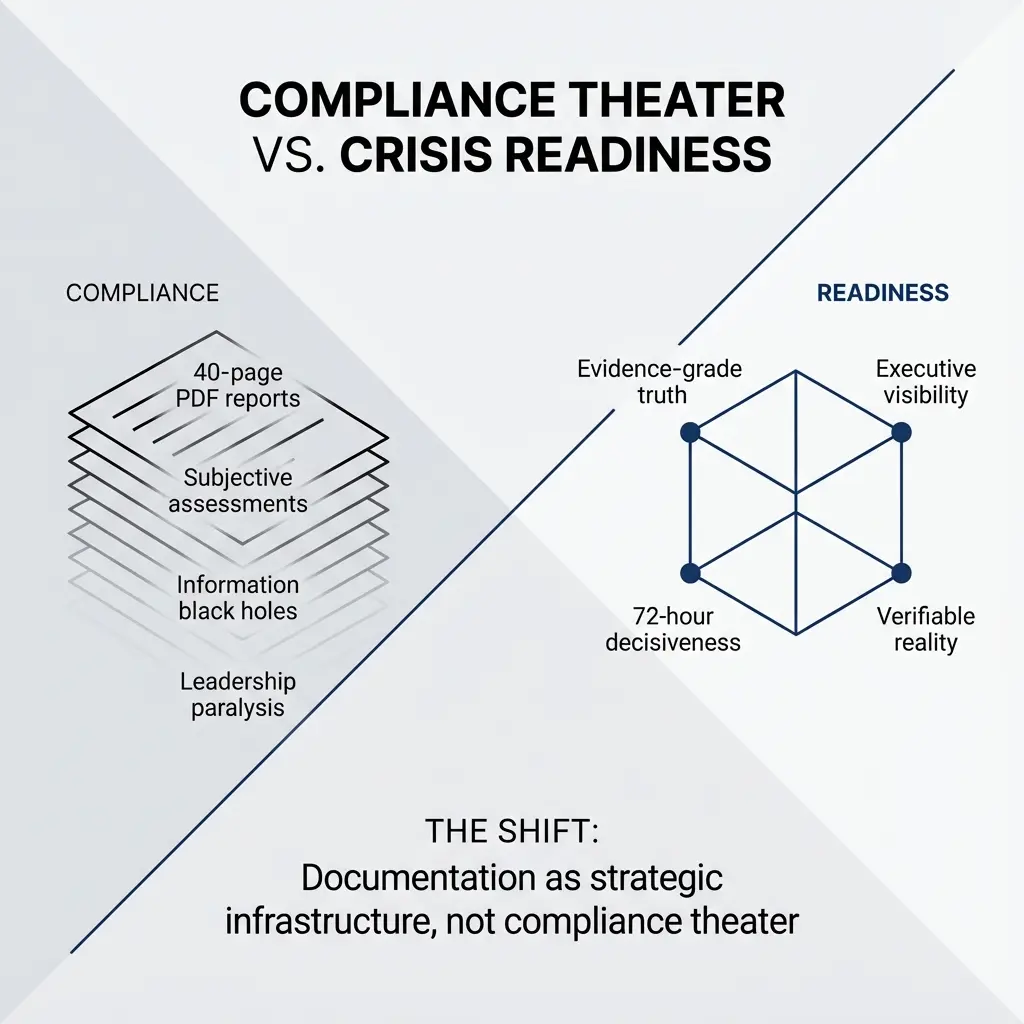
But here's the problem Oxford identifies: traditional property documentation is compliance theater.
The Compliance Theater of Property Risk
You hire an inspector. He shows up with a camera and a ladder. He spends four hours on site. He goes home and writes a 40-page PDF report guessing what might be important in the future.
That report sits in a Dropbox folder.
Three years later, when you need to know the exact condition of the roof membrane in Section C, you're reading through subjective prose hoping the inspector mentioned it. You're doing mental gymnastics trying to figure out where those dozen photos were actually taken.
Oxford says compliance-driven risk management causes leaders to "overestimate their control and underestimate timing considerations."
That PDF report creates the illusion of control. You have documentation. You're compliant. The box is checked.
Then the loss happens and you discover the documentation doesn't reflect reality. The inspector didn't photograph that area. The report doesn't mention that equipment. The condition assessment was subjective opinion, not verifiable fact.
You were compliant, but you weren't prepared.
Insurance industry research shows that "the more detailed your records, the faster your claim can be processed and the more likely the full settlement value of your claim can be realized." But traditional documentation systems allow "crucial information to be easily misplaced, damaged or destroyed—leaving huge amounts of data unaccounted for."
The 72-Hour Leadership Paralysis
Oxford warns that compliance frameworks create "leadership paralysis during actual crises."
I've watched this paralysis in real time during the first 72 hours after catastrophic loss.
You're trying to understand the totality of the damage. You're trying to report to stakeholders. You're trying to make decisions about reconstruction timelines and contractor deployment.
You can't answer basic questions.
What was actually there? What condition was it in? How do we prove it to the carrier? What's the reconstruction timeline based on actual scope?
Without verifiable pre-loss documentation, this becomes scrambling instead of strategic deployment. You're negotiating with your own insurance carrier about what existed. You're in an "inevitable negotiation as to what items were actually located in the affected buildings and thus what items were truly lost."
Oxford's principle that "failures often stem from unclear ownership" plays out exactly here.
The facilities team says they reported the roof issues. The insurance department says they weren't told. The executive team says they weren't aware of the severity. Everyone deflects because nobody has verifiable truth to point to.
Ambiguity is where accountability goes to die.
The Scared Underwriter Problem
Oxford talks about how "visible leadership engagement with risk builds organizational trust."
This principle transforms insurance relationships when you flip it around.
A scared underwriter is an expensive underwriter.
When carriers can't see your actual property conditions, they price in ambiguity. They assume the worst. They apply blanket approaches instead of risk-specific pricing. They build in margin for what they don't know.
Recent governance research confirms that "without visible support from senior leadership, GRC [Governance, Risk, Compliance] efforts may stall or be viewed as check-the-box activities."
When executives delegate property risk conversations to brokers and facilities teams, carriers see that delegation. They see leadership that doesn't own their physical asset risk. They price accordingly.
But when a CEO can demonstrate actual property conditions during underwriting conversations, everything changes.
Advanced digital twin implementations now achieve detail resolution down to "eighth of an inch hail hits," enabling property managers to "see every doorknob, see every latch, see every lighting fixture" in virtual twins.
Imagine sitting in a renewal meeting and pulling up a living digital twin of your property. The underwriter asks about roof condition. You show them every square foot, captured three months ago. They ask about HVAC maintenance. You show them documentation of every unit, all sides, with serial numbers extracted and tracked.
You just eliminated their fear. You just eliminated their need to price in ambiguity.
This is Oxford's visible leadership engagement applied to physical assets.
Evidence-Grade Truth as Leadership Infrastructure
Oxford calls for "accepting imperfect information and taking ownership despite uncertainty."
But here's what I've learned: you can dramatically reduce that uncertainty for physical assets.
The technology exists today to capture every square foot of a property, interior and exterior, and process it into a queryable digital twin. You can document literal granular detail. You can geolocate every photo. You can create an immutable record that serves as evidence in any dispute.
This is what we call a Capture Block™ in the Property Blockchain™ methodology.
It's a time-stamped, comprehensive documentation event that creates an unassailable source of truth. You're not guessing what the inspector thought was important. You captured everything. You can query it later when you know what questions to ask.
Research confirms that "pre-loss documentation acts as a safeguard against attempts to include pre-existing damage or inflate claims, protecting the carrier's bottom line" while simultaneously expediting coverage investigations and minimizing disputes.
When you have this foundation, Oxford's call for judgment-based risk decisions becomes possible.
You're not reading summaries. You're seeing actual conditions. You can visit ten properties in an hour meeting without leaving your office. You can make capital deployment decisions with surgical precision because the need is visually undeniable.
The information problem that made delegation rational is now solved.
From Reactive Compliance to Proactive Leadership
Oxford argues that "risk ownership should not be delegated solely to specialized departments."
For decades, executives had no choice but to delegate property risk. You couldn't fly around the country inspecting every building. You couldn't maintain that level of visibility at scale.
The bandwidth required was insurmountable.
But drone technology, digital twin processing, and evidence-grade documentation have eliminated that excuse. That logistics problem is solved. The cost is now lower than a single site visit with lodging and rental car.
Financial services risk analysis confirms that "historically, firms have been reactive. Even in times of less volatility, this approach has proven costly, inefficient, and largely ineffective." The 2025 regulatory landscape demands "proactive, repeatable strategies" using technology to "stay ahead of regulatory change."
This same shift needs to happen in physical asset risk management.
When you implement scheduled Capture Blocks across your portfolio, you're being proactive with information gathering. You're building the time-series documentation that lets you tell a narrative about each asset. You're creating the visibility that enables the leadership engagement Oxford demands.
Industry analysis reveals that "compliance trends for 2025 show that compliance is no longer just about box-ticking; it's a strategic imperative underpinning business resilience and reputation."
Property documentation must shift from procedural compliance to strategic leadership infrastructure.
The Competitive Advantage Oxford Identifies
Oxford's framework suggests that organizations integrating risk into strategic leadership move decisively while competitors remain paralyzed by compliance-driven ambiguity.
I'm watching this play out in real time.
Organizations that maintain Property Blockchain™ documentation make faster decisions. They deploy capital with confidence. They negotiate better insurance terms. They settle on scope of claims in measurements of days instead of months.
When everyone else is scrambling to figure out what they lost, you're showing verifiable pre-loss condition and moving to reconstruction.
When everyone else is arguing with carriers about coverage, you're presenting evidence-grade documentation that eliminates dispute.
When everyone else is trying to remember what the facility manager knew, you have institutional knowledge preserved in queryable digital twins.
Research shows that during the first 72 hours after catastrophic loss, organizations face critical triage decisions about damage extent, reporting, and reconstruction timelines. Without pre-loss documentation, this becomes "scrambling to find our best guess" rather than strategic deployment.
When pre and post-loss conditions are comparable, checks get cut faster by claims adjusters, especially large loss claims adjusters.
What Oxford's Framework Demands
Oxford's argument boils down to this: compliance without leadership ownership creates organizational blindness.
For physical assets, that means:
Stop delegating property risk to departments. Maintain executive visibility into actual conditions.
Stop accepting subjective reports as documentation. Demand evidence-grade truth that can withstand scrutiny.
Stop treating documentation as compliance theater. Build it as strategic infrastructure for decision-making.
Stop pricing in ambiguity. Eliminate carrier fear with verifiable reality.
Stop creating Information Black Holes. Preserve institutional knowledge in systems that outlast personnel changes.
The technology exists. The methodology exists. The cost is justified by a single prevented dispute or a single faster claim settlement. Not to mention how the same dataset can be used for operational efficiencies, due-diligence, acquisitions, and marketing as well.
What's missing is the leadership decision to own physical asset risk instead of delegating it.
Oxford's framework shows why that decision matters. Organizations that integrate risk into strategic leadership build resilience. Organizations that delegate risk to compliance departments build vulnerability disguised as process.
The question is which organization you're building.
Because when the crisis hits, your compliance documentation won't save you.