The $8 Billion Question: Why Are Insurance Brokers Still Subsidizing Lawyers Instead of Eliminating Litigation?
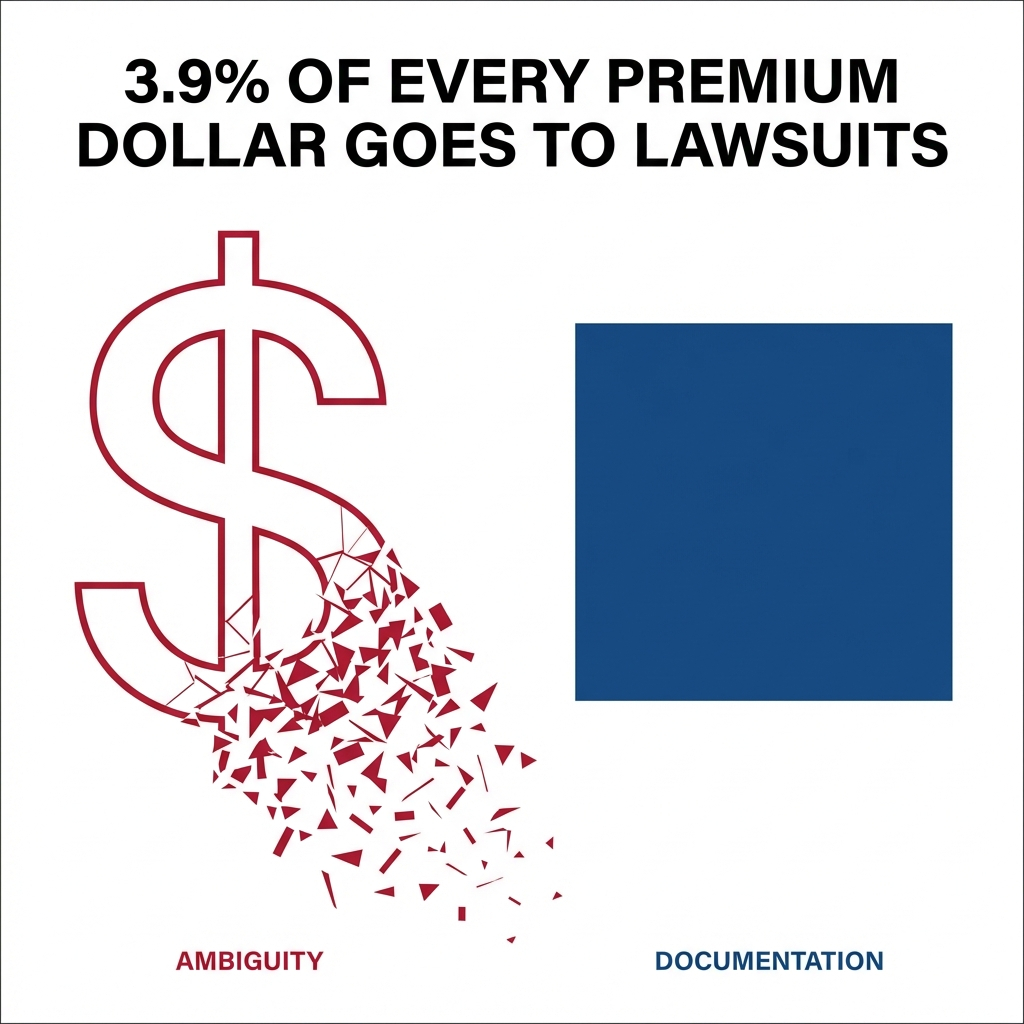
Billions of dollars disappear every year in the property insurance industry.
Not to catastrophes. Not to fraud. Not even to inflated repair costs.
To lawyers arguing about what existed before the loss.
This is a completely solvable problem. The technology exists. The methodology exists. What's missing is industry-wide recognition that ambiguity in pre-loss documentation isn't just expensive. It's existential.
The 3.9% Tax Every Policyholder Pays (And Nobody Talks About)
3.9% of every premium dollar goes to defense costs and litigation expenses.
Across U.S. property and casualty insurance, that's billions of dollars annually. In Florida (ground zero for insurance litigation) it peaked at 6.6% in 2022. Even after tort reform, it's still 5.1%.
Think about that. For every $100,000 in premium, $3,900 to $6,600 goes to lawyers. Not to claims. Not to repairs. Not to policyholders.
To arguing about what existed before the loss.
According to Swiss Re Institute, social inflation driven primarily by rising litigation costs increased liability claims by 57% over the past decade, reaching an annual peak growth rate of 7% in 2023.
Survey data from late 2025 shows that 64.3% of insurance consumers understand they're paying for unnecessary lawsuits through higher premiums. An overwhelming 84.3% would support reforms if they knew certain legal practices were driving up their costs.
The market knows there's a problem. What they don't know is that the solution isn't tort reform.
It's eliminating the ambiguity that makes litigation profitable in the first place.
Why Traditional Documentation Is a Litigation Factory
Here's how property insurance documentation works today:
Step 1: The ACORD Application
An insurance submission starts with an ACORD form. Name, rank, and serial number for a building. Square footage. Year built. Roof age. HVAC update year.
It's the equivalent of judging someone's health based on their driver's license.
Step 2: The Property Condition Assessment
Carriers know the ACORD form isn't enough. So they hire experts to conduct property condition assessments. Third parties go out, walk the property, take photos, write a report.
Here's the problem: two inspectors produce two different reports.
Three inspectors? Three different emphases. Three different conclusions.
Why? Because they're humans with limited time, subjective judgment, and selective attention. An inspector can't document every square foot. They can't photograph every HVAC unit from every angle. They can't capture every roof condition, every window, every potential point of failure.
They document what they think matters. They write reports anticipating what might be important in a future claim scenario.
But nobody knows what the future will bring. Nobody knows which detail will become the $2 million dispute three years from now.
Step 3: The Loss Event
A hurricane hits. A fire breaks out. Hail damages the roof.
Now everyone pulls out their documentation:
- The carrier has a report saying the HVAC units were "fair condition."
- The policyholder has photos they took six months ago showing something different.
- The public adjuster produces their own assessment.
- The carrier sends their adjuster, who produces a fourth interpretation.
Nobody can prove what existed on every square foot before the loss.
That's not a documentation problem. That's a litigation goldmine.
The Capture Block™: How to Eliminate Ambiguity at the Source
Here's what changes when you document a property with the Property Blockchain™ methodology using Capture Blocks:
Every square foot. Interior and exterior. Documented objectively.
Drones with waypoint flights capture the exterior. Every roof section. Every HVAC unit from every angle. Every window. Every potential point of damage or failure.
360-degree cameras capture the interior. Every room. Every ceiling. Every floor. Every fixture.
The result isn't a report. It's not someone's interpretation of what matters.
It's a navigable digital twin of site reality. This is NOT a virtual tour.
Think of it as a 3D photo filing system. You can walk through it virtually. You can measure from it. You can query it. You can zoom into any detail, any angle, any square foot and see exactly what existed at the time of capture.
No interpretation required. No selective documentation. No "expert opinion" about what was fair versus poor condition.
Just verifiable reality.
What This Means for Claims
When a loss occurs, there's no argument about pre-loss condition.
You pull up the Capture Block. You show exactly what existed. You compare it to post-loss Capture Block documentation before even arriving on site.
- The adjuster can't claim the HVAC was already in poor condition if the Capture Block shows otherwise.
- The policyholder can't inflate pre-loss value if the documentation proves different.
- The carrier can't underpay if the evidence is clear.
Ambiguity dies. Litigation becomes pointless.
That 3.9% to 6.6% of premium that's currently going to lawyers? It can be redirected to actually reducing premiums, improving coverage, or enhancing service.
But here's the thing: this isn't theoretical. It's happening now.
Why Brokers Should Care (And Act Now)
For insurance brokers, this represents a competitive advantage built on measurable value delivery.
Consider the business case:
- Client retention: When policyholders have comprehensive pre-loss documentation, claims settlements are faster, less contentious, and more favorable. They remember who provided that protection.
- New business: Brokers can approach prospects with a genuine value proposition that goes beyond price shopping. "We eliminate the litigation risk that's costing you 4-6% of your premium."
- Carrier relationships: Delivering risks with evidence-grade documentation means better pricing, better terms, better placement options.
This isn't about selling drones. It's about solving the most expensive problem in property insurance.
There's a secondary benefit worth noting: as deepfake fraud attempts surge (up 2,137% in three years, now accounting for 6.5% of detected identity fraud cases), cryptographically verified documentation becomes essential infrastructure. But that's future-proofing. The immediate ROI is litigation avoidance.
Companies capturing property data need systematic verification approaches. Without cryptographic authentication at the point of capture, there's no defense against claims of manipulation or selective documentation.
Traditional inspection methods can't provide immutable proof of authenticity. As Coalition Insurance noted when launching the first Deepfake Response Endorsement in December 2025, humans "can only really rely on heuristics" for deepfake detection. That's not sufficient for evidence-grade documentation.
Cryptographic hashing at capture creates verifiable authentication. Rather than defending against accusations of altered documentation, stakeholders have mathematical proof of authenticity.
The ROI Math Is Simple
Consider a concrete example.
A $10 million commercial property with a $250,000 annual premium.
At 3.9% litigation reserve, that's $9,750 per year going to legal costs rather than coverage.
Over a 5-year policy period: $48,750.
At Florida's 5.1% rate: $63,750 over five years.
Now, what does a comprehensive Capture Block cost for that property?
A fraction of one year's litigation reserve.
And it's not a one-time benefit. Every renewal cycle, every claim scenario, every stakeholder dispute avoided: the ROI compounds.
If it saves one contentious claim negotiation, the investment returns 10x. If it prevents one lawsuit?
It transforms the entire risk profile.
What Brokers Need to Do Now
For insurance brokers, comprehensive pre-loss documentation provides three strategic advantages:
Client retention: When your policyholders have comprehensive pre-loss documentation, claims settle faster and more favorably. They remember who provided that.
New business: You have a value proposition that goes beyond price shopping. "We eliminate the litigation risk costing you 4-6% of premium."
Carrier relationships: You're delivering evidence-grade risk documentation. That means better pricing, better terms, better placement.
This isn't about selling drones. It's about solving the most expensive problem in property insurance.
The brokers who adopt this methodology first will establish market position based on demonstrable litigation cost reduction.
The Market Is Demanding This Now
Survey data from late 2025 shows that 64.3% of insurance consumers know lawsuits are increasing their premiums. An overwhelming 84.3% would support reforms if they understood which practices were driving up costs.
The market knows there's a problem. They're asking questions.
Policyholders see technology advancing everywhere. Then they look at insurance documentation (a person with a camera writing a subjective report) and ask: "Why are we doing this like it's 1995?"
No one would close a real estate deal based on satellite imagery and algorithmic guesses.
So why accept that for insurance policies worth millions?
The answer used to be: "Because there's no better way."
That's no longer true.
The Question Isn't "If." It's "When."
Comprehensive property documentation will become standard. The litigation costs alone guarantee it.
The only question is: will an organization be early or late?
The early brokers will build competitive moats. They'll have client relationships cemented by genuine value delivery. They'll have carrier partnerships built on evidence-grade risk documentation.
The late ones will be playing catch-up in a market that's already moved on.
Brokers who aren't discussing litigation cost reduction with clients are ceding competitive ground.
When policyholders understand they're paying 4-6% of premium to subsidize legal disputes over ambiguous documentation, they'll demand alternatives.
The technology exists. The methodology exists. The ROI is undeniable.
The only variable is adoption timing.